
How to Get a Job Fast on LinkedIn and Naukri (Step-by-Step Guide)
The landscape of work has undergone a seismic shift over the past two decades. Having worked in the corporate world, I’ve witnessed multiple technology cycles firsthand—most notably the 4G revolution that put smartphones into almost every hand across the globe.
When smartphones became ubiquitous, millions of people began treating that small glass rectangle as the centre of their universe. While technology is undeniably powerful, many lost sight of a fundamental truth: the most important thing we need to secure our lives is financial stability.
Financial independence is achieved primarily through two avenues: building a business or securing a job.
Starting a business requires capital and investment. Typically, that investment comes from venture capitalists. For a middle-class individual, however, their “venture capitalists” are usually their parents, teachers, or supportive friends. Unless you are exceptionally lucky, a millionaire isn’t going to walk up and fund your early idea on day one.
For the vast majority of society, the most accessible and reliable path to financial security remains straightforward: study diligently, acquire practical skills, land a solid job, and earn a livelihood to satisfy your needs (and maybe a few greeds along the way!).
It is crucial to remember that money earned through genuine hard work carries long-term value. Shortcuts to quick money rarely last; they often bring anxiety, instability, and regret.
To navigate today’s competitive landscape effectively, you need to balance two things: confidence in your skills and an accurate reading of current market dynamics.
The Reality of the Modern Job Market

Today’s fast-paced tech and corporate sectors often post job requirements that look as though they are searching for a superhero rather than a human professional. Every organization wants elite talent, but the harsh truth is that most companies are also actively looking for the most cost-effective manpower available.
While that reality can be tough to digest, it is largely driven by global supply and demand dynamics, particularly in high-population talent pools like India, Pakistan, Bangladesh, and the Philippines. Millions of young professionals enter the technology sector simultaneously. When supply vast exceeds demand, compensation scales flatten. As a result, surveys show that over 71% of working professionals in India feel underpaid—a trend that continues to grow year over year.
To stand out in this crowded market, you must understand how the hiring machinery actually operates under the hood.
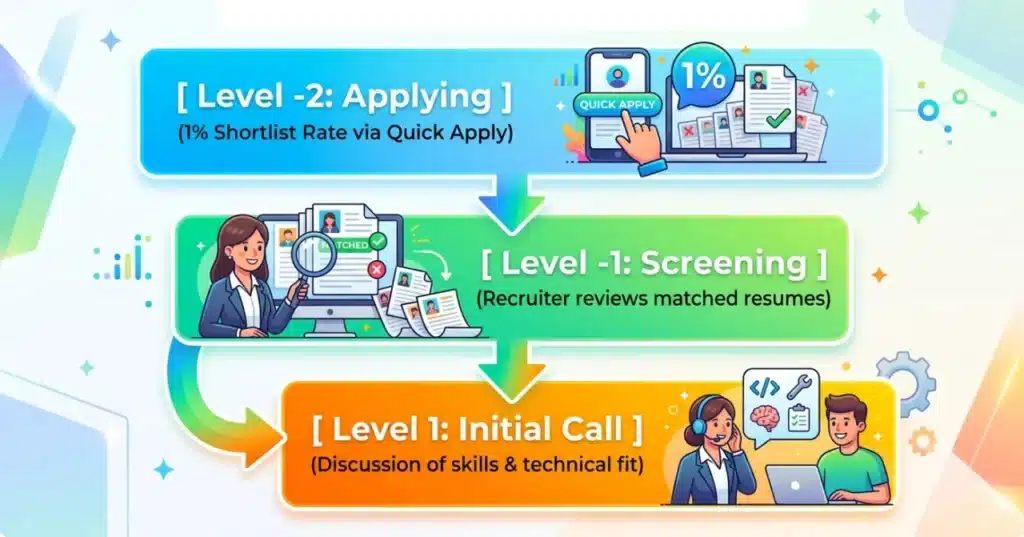
When you hit “Apply,” you aren’t at step one of the hiring process. You are actually at Level -2.
- Level -2: Clicking “Apply Now” or “Easy Apply” on platforms like Naukri or LinkedIn.
- Level -1: A recruiter actually reviews your application and resume.
- Level 1: The recruiter calls you directly for an initial screening interview.
Understanding these tiers allows you to stop applying blindly and start optimizing your approach strategically.
How to Optimize Your Job Applications (Level -2)

When you rely exclusively on one-click applications on portals like Naukri or LinkedIn, your chances of getting shortlisted sit at a dismal 1%.
Hitting “Quick Apply” hundreds of times a day without modification is inefficient. You don’t need to stop applying altogether, but you must change how you apply by following three core rules:
1. Achieve a High Skill Match
Before submitting your resume, ensure that at least 90–95% of the core skills listed in the job posting are explicitly reflected in your resume. Modern applicant tracking systems (ATS) and recruiters scan for direct relevance. If the match is weak, your application gets filtered out automatically.
2. Align Locations Strictly
Ensure your preferred location matches the operating location of the hiring company. Unless a role is explicitly listed as 100% remote, location mismatches are one of the fastest reasons applications get discarded.
3. Target Fresh Postings
Focus your efforts on job postings published within the last 3 to 4 days. Applying to postings that have been active for weeks often means the recruiter is already in late-stage interviews with candidates who applied early.
The Power of Referrals and Strategic Networking
If you want to bypass Level -2 and Level -1 entirely to land straight at Level 1 (The Recruiter Call), your best tool is a strong referral network.
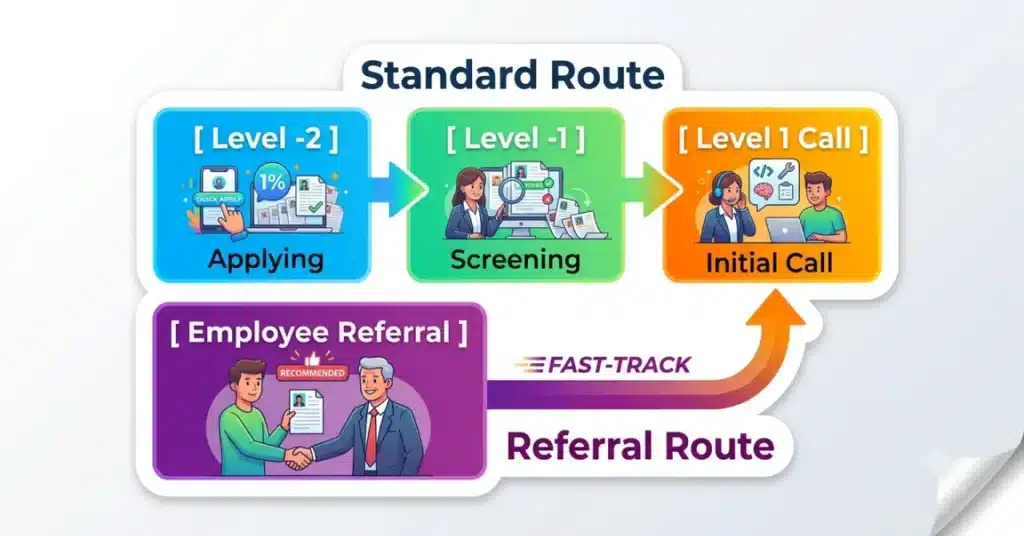
A direct referral from an employee working inside your target company significantly raises your profile visibility. However, referrals come with specific requirements:
- Know the Role Intimately: Do not ask a contact for “any open role.” Request a referral for a specific Job ID that matches your skill set.
- Be Interview-Ready: A referral gets your resume seen, but your skills must clear the technical assessments and interviews. Ensure your core competencies are sharp before asking someone to put their professional reputation on the line for you.
Building Profile Visibility on LinkedIn
To attract recruiters organically, your profile needs consistent reach and engagement. One of the best ways to build credibility is by sharing high-value, public updates regularly.
Essential Rules for Engagement & Optimization
1. Posting Frequency
- Recommended Approach : Post clear, industry-relevant content consistently.
- Common Mistake to Avoid: Posting generic, fluff content without personal context.
2. Hashtag Usage
- Recommended Approach : Use 3 to 4 targeted, high-volume hashtags.
- Common Mistake to Avoid: Overloading posts with 15+ hashtags (triggers spam filters).
3. Tagging Entities
- Recommended Approach : Tag relevant tools, broad skill categories, or organizations naturally.
- Common Mistake to Avoid: Tagging dozens of unassociated accounts to force reach.
When you over-index on hashtags or mass-tag irrelevant accounts, platform algorithms reduce your reach, capping your views at a fraction of your actual network size. Keep your formatting clean, clear, and professional.
Continuous Skill Upgradation: The Key to Long-Term Growth
Landing a job—even if it isn’t your dream position immediately—is an essential step toward building momentum. A initial position provides financial stability, practical experience, and a platform to build from.
Once you are employed, the work doesn’t stop. Continuous skill development is what dictates your long-term career trajectory.
- Upskill While Working: Treat your current role as both an income source and an incubator. Dedicate time each week to learn emerging tools and frameworks in your field.
- Earn Recognized Certifications: Relevant, industry-backed achievements serve as tangible proof of your evolving capabilities.
- Stay Interview-Ready: By keeping your technical foundation sharp, you won’t need to panic-prepare when a major opportunity presents itself.
Always keep in mind: while you are relaxing at home, someone else is actively working on their skill set, refining their projects, and polishing their resume for the exact role you want. Consistent effort is your primary edge.
Conclusion & Key Takeaways
After completing your education, your primary objective should be securing a role at a legitimate, properly registered company—one that provides clear employment records, standard benefits, and consistent compensation.
Once you have established a steady baseline, use that foundation to fund your growth. Polish your core technical skills, track market shifts, and position yourself thoughtfully across professional platforms.
Key Summary Steps:
- Stop Blind-Applying: Focus on quality applications matching 90%+ of required skills on postings under 4 days old.
- Leverage Warm Connections: Seek targeted referrals for specific positions rather than broadcasting general requests.
- Build Thoughtful Visibility: Share insights on LinkedIn using clean, focused formatting (3–4 relevant hashtags).
- Never Stop Upskilling: Keep your technical domain knowledge current regardless of your current job status.
A Note to Corporate Leaders and Tech Professionals
To startup founders, hiring managers, and corporate leaders: treating applicants with clarity and fairness builds long-term employer brand equity. While automated platforms and AI screeners streamline workflows, over-relying on uncalibrated filtering tools often results in missing exceptional talent. Human review remains essential to evaluating context, problem-solving ability, and growth potential.
To professionals utilizing modern generative AI tools: always review and quality-assure your output. Whether you are writing code, drafting content, or generating design assets, using AI blindly without validating structure, brand guidelines, or output quality weakens your professional reputation. Technology is an accelerator, but personal accountability and attention to detail are what set true professionals apart.