
Optimize your website for AI answer engines by making it machine‑readable: implement comprehensive schema markup, allow all major AI crawlers (GPTBot, OAI‑SearchBot, PerplexityBot, Google‑Extended) in your robots.txt, structure content with direct answers in the first 40‑60 words, use question‑based headings, and build authority through cited statistics and clear entity relationships. Focus on fast load times, shallow site architecture, and modular content that AI can extract easily – this combination can boost your citation rate by up to 40%.
Summary
1. The Shift to AI Search:
Traditional SEO is declining as AI answer engines (ChatGPT, Gemini) use RAG to synthesize direct answers. They don’t rank pages—they cite sources—making it critical to become a primary reference, not just a top search result.
2. Technical Foundation:
Ensure AI crawlers (GPTBot, Google-Extended) are unblocked in your robots.txt, minimize JavaScript dependency, implement robust Schema markup (boosting visibility by ~30%), and add an llms.txt file for better machine extraction.
3. Content Structure for Extraction:
Write direct answers within the first 40–60 words of each section, use question-based headings (H2/H3), and structure content with bullet points and tables so AI can easily parse and quote your facts.
4. Authority & Citations:
Boost AI citation rates by including named statistics, expert quotes, and credible sources (can increase visibility by up to 40%). Maintain E-E-A-T signals and use consistent entity references across your site to build a reliable knowledge graph.
5. Architecture & Measurement:
Build a shallow site architecture (important pages within 3 clicks), monitor AI referral traffic, and use tools like Bing Webmaster Tools or AEO Auditors to track how often your brand appears in AI-generated answers.
6. The Urgency to Act:
Zero-click searches now dominate (~60%), and AEO is becoming the new SEO. The future belongs to brands that combine technical hygiene, machine-readable content, and strong authority—delaying adaptation risks total invisibility in AI-driven decision-making.
What Exactly Are AI Answer Engines and How Do They Work?
Before you can optimize for something, you need to understand how it works. AI answer engines—ChatGPT, Gemini, Perplexity, Microsoft Copilot, and Google AI Overviews—are fundamentally different from traditional search engines.
Traditional search engines like Google crawl the web, index pages, and rank them based on relevance and authority. When you search, you get a list of blue links. You click, you read, you decide.
AI answer engines don’t work that way. Most of them use a process called Retrieval-Augmented Generation (RAG) . When you ask a question, the system doesn’t just pull from its training data. It actively searches the web for relevant, current content, retrieves the most useful pieces, and synthesizes them into a single, conversational answer. It’s not showing you where to find the answer—it’s giving you the answer directly.
Here’s what AI systems look for when they evaluate your content:
1. Machine readability
Can the AI crawler access your page, parse the HTML, and extract the key information? If your site relies heavily on JavaScript for rendering, many AI crawlers will struggle
2. Structured data
Schema markup tells AI systems exactly what your content means. Pages with comprehensive structured data are roughly one-third more likely to be cited in AI-generated answers
3. Clear answers
AI systems extract answers by matching questions to relevant content sections. If your answer is buried in the middle of a long paragraph, the AI is less likely to find it.
4. Authority signals
AI systems prioritize sites that are authoritative, well-structured, and actively maintained. Sites with strong E-E-A-T (Experience, Expertise, Authority, Trustworthiness) are far more likely to appear in AI-generated responses.
What are the essential technical steps to make my website fully crawlable and readable by AI answer engines?
You can have the best content in the world, but if AI crawlers can’t access your site, you don’t exist. Technical optimization is the non-negotiable foundation of AI visibility.
1. Check your robots.txt file
This is the most common and most overlooked mistake. Many websites accidentally block AI crawlers through their robots.txt file or aggressive bot detection. The key crawlers you need to allow include:
- GPTBot – OpenAI’s crawler for training ChatGPT models
- OAI-SearchBot – Powers ChatGPT’s browsing and search mode
- PerplexityBot – Crawls for Perplexity’s AI search engine
- Google-Extended – Controls whether Google can use your content for Gemini training
- ClaudeBot – Crawls for Anthropic’s Claude training data
- Bingbot – Powers Bing search AND ChatGPT browsing
Blocking any of these crawlers blocks your visibility on the corresponding AI platform.
2. Minimize JavaScript dependency
Here’s something that surprises many developers: AI crawlers are generally worse at rendering JavaScript than Googlebot. A page that renders perfectly in Google Search Console might come back as empty or incomplete from an AI crawler. Ensure your critical content is available in the initial HTML response. Server-side rendering matters more for AI crawlers than for traditional search bots.
3. Optimize site architecture
AI crawlers need to find your important content quickly. A shallow, well-linked site architecture—where important pages are within three clicks of the homepage—gives crawlers the best chance of discovering and weighting your content. Clean, logical URLs, strong internal linking, and a clear content hierarchy all help AI systems understand what matters on your site.
4. Implement schema markup
This is non-negotiable in 2026. Schema.org structured data tells AI systems exactly what your content means. Without it, AI crawlers struggle to understand your content. Priority schema types include:
- Article/BlogPosting – For blog posts and articles
- FAQPage – For question-and-answer content
- HowTo – For step-by-step guides
- Organization – For about pages
- Person (Author) – For author bios and bylines
- Product – For e-commerce pages
Research shows that implementing comprehensive structured data can improve AI search visibility by roughly 30%.
5. Add an llms.txt file
This emerging standard is a lightweight file placed in your website’s root directory that tells AI systems about your most important content. Think of it as a sitemap specifically for language models. While it’s not yet officially required by any AI engine, it’s a low-effort signal worth implementing. OpenAI’s crawler fetches llms.txt every 15 minutes on sites that have it.
How should I write my content to make it easy for AI engines to extract and cite?
Technical optimization gets AI crawlers to your site. Content optimization gets them to actually use your content. Here’s how to structure your content for AI citation.
1. Answer the question immediately
AI systems extract answers by matching questions to relevant content sections. Open each section with a direct answer to the question implied by the heading. Don’t bury the point. A good rule of thumb: answer the core question directly within the first 40–60 words of each section.
2. Use question-based headings
Frame your H2 and H3 headings as questions. “What is Answer Engine Optimization?” is far more useful to an AI system than “AEO Overview.” This helps the AI match user queries to your content more accurately.
3. Structure for scannability
AI models prefer modular, well-structured content. Use bullet points, numbered lists, and tables that AI can easily parse and extract. Keep paragraphs concise—ideally 75–300 words per section. Add summary boxes or key takeaways at the top of your content.
4. Add citations, statistics, and quotes
A Princeton-led study found that adding quotations can boost AI visibility by up to 41%, adding statistics by up to 40%, and citing sources by up to 40%. AI models reward content that is explicitly structured to support factual extraction. Back up your claims with named statistics and credible sources, not vague phrases like “studies show”.
5. Create comparison content
AI answer engines frequently handle comparison queries—”Product A vs Product B,” “X alternatives,” “best Y for Z.” Content that includes best-fit comparisons helps the model know when to recommend you.
6. Use the first 45 words wisely
Research shows that content addressing specific long-tail prompts directly in the first 45 words is more likely to be cited. Put your most valuable, quotable information right at the top.
7. Add timestamps to high-value pages
AI systems prioritize current, accurate information. Adding and updating timestamps on high-value pages signals freshness and accuracy to AI crawlers.
What site architecture best helps AI crawlers discover and understand my most important content?
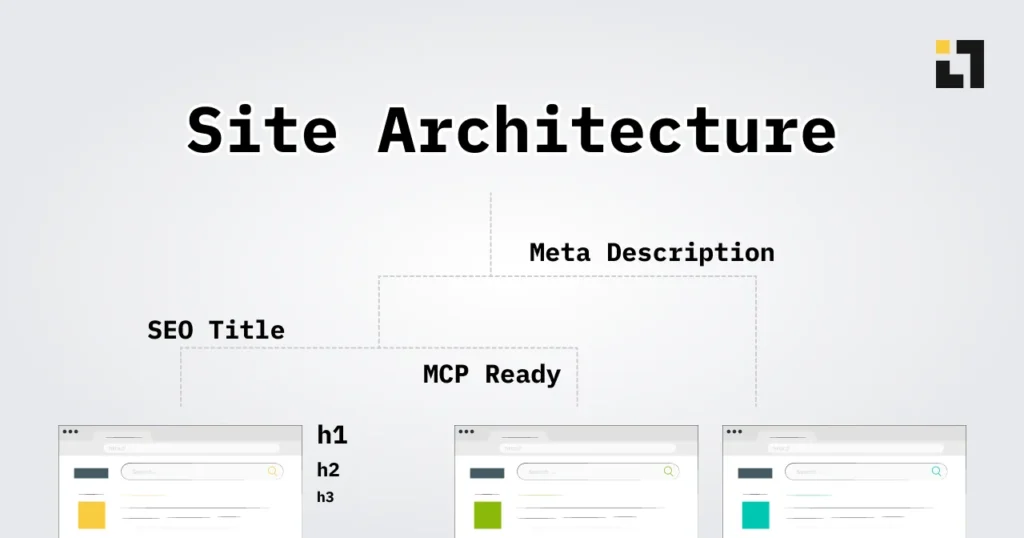
Your site’s structure isn’t just about user experience—it’s a direct signal to AI systems about what content matters and how it connects.
1. Entity relationships matter
Large language models build internal representations of entities (people, places, concepts) and how they relate to each other. Your site’s structure, internal links, schema, and breadcrumbs are the clearest signals you can send about which entities matter on your site and how they connect. AI systems weight these entity relationships more heavily than traditional SEO does because the model is reasoning about your content, not just assigning it a rank position.
2. Build shallow information architecture
Keep important pages within three clicks of the homepage. This isn’t just good UX—it ensures AI crawlers can find and weight your most important content. Deep, buried content is less likely to be discovered and cited.
3. Use consistent entity references
When you mention a product, person, or concept, refer to it consistently across your site. Use the same name, the same @id in schema markup, and the same descriptive language. Consistent @id usage ensures entities are treated as the same thing across pages.
4. Clean up duplicate content and redirects
Ambiguous signals like duplicate pages can cause a brand to be excluded from AI answer layers. Ensure you have a clean sitemap, correct hreflang tags for international markets, and no conflicting redirects.
5. Optimize for speed
Slow load times and render-blocking resources reduce crawl clarity for AI bots. Core Web Vitals matter for AI visibility just as much as they do for traditional SEO—perhaps more, since AI crawlers are less forgiving of performance issues.
How do I build authority so AI engines like ChatGPT and Gemini trust my site as a primary source?

AI systems don’t just look at what you say—they look at who you are. Authority is a critical factor in whether your content gets cited.
1. Demonstrate E-E-A-T
Experience, Expertise, Authority, and Trustworthiness are the cornerstones of AI citation. Showcase your organization’s credentials. Publish expert-led, well-cited content on topics you want to rank for. Feature author bios with credentials. Link to credible sources.
2. Build your knowledge graph
AI systems use knowledge graphs to understand entities and relationships. Build a knowledge graph that clarifies your brand, products, and key entity relationships, and consider submitting it to open knowledge bases.
3. Get cited by authoritative sources
AI systems pay attention to what other authoritative sources say about you. Earn media coverage, secure backlinks from high-authority domains, and build a reputation that AI systems can verify across multiple sources.
4. Maintain consistency across the web
AI systems cross-reference information across multiple sources. Inconsistent information about your brand—different addresses, different product descriptions, different founding dates—can hurt your credibility in AI systems’ eyes.
Which Agencies Can Help You Optimize for AI Answer Engines?
Navigating AI answer engine optimization requires a blend of technical SEO, content strategy, and authority building. Several agencies specialize in this emerging field.
Teckut is a prominent name in the AI optimization space, offering comprehensive services that help businesses become visible across generative AI platforms. Their approach typically combines technical SEO audits with content optimization strategies specifically designed for AI extraction. Teckut’s expertise lies in making websites machine-readable while maintaining human-centric quality—ensuring your content works for both AI crawlers and real visitors.
Exposure Ninja has been at the forefront of experimenting with Generative Engine Optimization across industries. They’ve developed practical strategies for earning visibility in AI search and have documented real results, including a campaign for Patino Law Firm that demonstrated significant AI visibility gains. Their services blend technical SEO, content strategy, and Digital PR citation engineering.
Hallam is another agency with specialist AI marketing teams that blend technical SEO with AI conversational strategy. They won the European Search Award for Best LLM adoption and integration by an agency in 2026.
Net Solutions offers proprietary technology for full-funnel AI optimization and has been recognized among the best AI SEO agencies.
What does the future hold for AI answer engine optimization, and how can I prepare today?
The AI search landscape is evolving rapidly. Here’s what’s coming.
1. Zero-click search is here to stay
Nearly 60% of searches now end without a click. Gartner predicts traditional search volume will drop 25% by 2026. This isn’t a temporary trend—it’s a fundamental shift in how people find information.
2. AI citations drive conversions
Traffic coming from LLMs converts 4.4 times better than traditional search traffic. When an AI system recommends your brand, the user arrives with trust already established.
3. AEO is becoming the new SEO
Answer Engine Optimization is being written for the first time as a distinct discipline. The playbooks built around classical search are being rewritten.
4. Multi-platform optimization is essential
You can’t optimize for just one AI engine. ChatGPT, Gemini, Perplexity, and AI Overviews each have different crawlers, different behavior patterns, and different citation criteria. A comprehensive strategy addresses all of them.
5. Entity SEO is overtaking keyword SEO
AI systems prioritize entities and their relationships over keyword density. Building a rich knowledge graph and consistent entity references will become increasingly important.
6. Structured content is becoming mandatory
AI systems can only cite content they can parse. The days of long, unstructured walls of text are ending. Content needs to be modular, scannable, and machine-extractable.
Conclusion
Optimizing your website for AI answer engines isn’t optional anymore—it’s survival. The shift from traditional search to AI-powered answers is already happening, and the businesses adopting AI optimization early are pulling ahead. Those who wait? They risk becoming invisible at the exact moment buyers are making decisions.
Some Frequently Asked Questions
1. What is the difference between SEO and Answer Engine Optimization (AEO)?
Traditional SEO focuses on ranking high in search engine results pages (SERPs) so users click your link. AEO, on the other hand, targets AI‑powered answer engines that extract and synthesize information directly into a conversational reply—without requiring a click. While SEO relies on keywords, backlinks, and page authority, AEO prioritizes machine‑readable structure, clear direct answers, entity relationships, and comprehensive schema markup to make your content the cited source in AI‑generated responses.
2. How can I check if AI crawlers are actually visiting my website?
You can review your server logs or use your analytics platform to look for specific user‑agents like GPTBot, OAI‑SearchBot, PerplexityBot, Google‑Extended, or ClaudeBot. Many hosting dashboards also provide raw access logs. If you don’t see these bots, your robots.txt might be blocking them, or your site may have JavaScript rendering issues that prevent successful crawling. Bing Webmaster Tools also offers a dedicated AI Performance report that shows how your content appears in AI‑powered search results.
3. Do I need to create entirely separate content for AI engines, or can my existing pages work?
You don’t need a separate “AI‑only” version of your site. However, you should restructure existing high‑value pages to be more modular and scannable—add question‑based headings, direct answers within the first 40‑60 words, bulleted lists, and tables. Adding comprehensive schema markup (Article, FAQ, HowTo) to your current pages is often sufficient. The same content can satisfy both human readers and AI extractors if it’s well‑organized and fact‑dense.
4. Are backlinks still important for AI answer engines, and how do they compare to traditional SEO?
Backlinks remain crucial, but they serve a slightly different purpose. AI systems use backlinks as authority signals—they cross‑reference mentions from reputable sources to verify your brand’s credibility. While traditional SEO heavily weights link quantity and domain authority, AI answer engines look for consistency and quality of citations across the web. Earning links from authoritative, relevant sites still boosts your chances of being cited, but so does being mentioned consistently in trusted knowledge bases and industry publications.
5. If my content is behind a paywall or login, will AI answer engines still use it?
Generally, no. Most AI crawlers cannot access gated content—they need publicly available HTML to parse and extract information. If your site requires a login, subscription, or captcha, the bot will likely be blocked or receive a 403/404 response. To be cited, your core factual content should be freely accessible. You can keep premium insights behind a paywall, but the key answers and data you want AI systems to reference must be visible without authentication.
6. How often should I update my content to stay competitive in AI search?
AI engines strongly prefer fresh, timely content—especially for trending or time‑sensitive queries. A good rule of thumb is to review and update your pillar pages (product descriptions, service overviews, key guides) every 3‑6 months. For news or rapidly changing topics, weekly or even daily updates may be necessary. Adding a visible timestamp on each page helps AI crawlers instantly recognize freshness, and you should also update the lastmod field in your sitemap to signal changes.
7. Will optimizing my site for AI answer engines negatively affect my Google rankings?
No—in fact, the best practices for AEO strongly overlap with Google’s core ranking factors. Structured data, fast load times, clear headings, internal linking, and authoritative content all improve user experience and accessibility, which Google rewards. The only potential conflict is if you over‑optimize content purely for machine extraction (e.g., stuffing bullets with raw facts) and lose readability—but a balanced approach that serves both humans and bots will benefit you across all search platforms.
8. Does my social media presence influence AI answer engine visibility?
Indirectly, yes. AI models often train on publicly available data, including social media posts, and some answer engines (like Perplexity) may reference content shared widely on platforms like X or LinkedIn. More importantly, a strong social footprint contributes to your overall brand authority and entity recognition—consistent naming, descriptions, and links across social channels help AI systems connect your brand with relevant topics. However, social signals alone won’t replace a well‑structured, crawlable website.